
Prostate cancer Also called: prostatic carcinoma

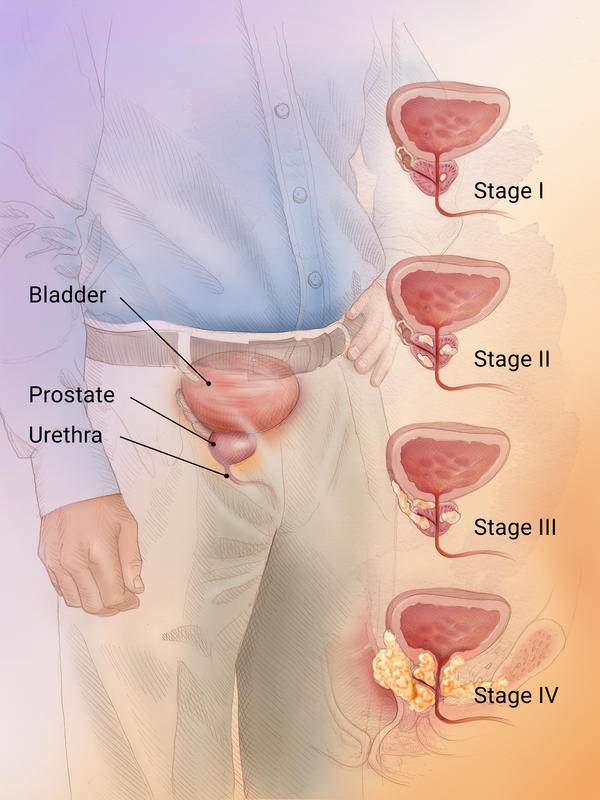
A cancer in a man's prostate, a small walnut-shaped gland that produces seminal fluid.
Very common
More than 3 million US cases per year
A man's prostate produces the seminal fluid that nourishes and transports sperm.
Symptoms include difficulty with urination, but sometimes there are no symptoms at all.
Some types of prostate cancer grow slowly. In those cases, monitoring is recommended. Other types are aggressive and require radiation, surgery, hormone therapy, chemotherapy, or other treatments.
Ages affected
| 0-2 |
|
| 3-5 |
|
| 6-13 |
|
| 14-18 |
|
| 19-40 |
|
| 41-60 |
|
| 60+ |
|
Genders affected
| Males |
|
| Females |
|
Requires a medical diagnosis
Symptoms include difficulty with urination, but sometimes there are no symptoms at all.
People may experience:
Pain: can occur during urination or in the bone
Urinary: difficulty starting and maintaining a steady stream of urine, dribbling of urine, excessive urination at night, frequent urination, urge to urinate and leaking, urinary retention, or weak urinary stream
Also common: erectile dysfunction
Treatable by a medical professional
Some types of prostate cancer grow slowly. In those cases, monitoring is recommended. Other types are aggressive and require radiation, surgery, hormone therapy, chemotherapy, or other treatments.
Prescription
Chemotherapy regimen: Cabazitaxel by injection, Docetaxel by injection (Docefrez)
Hormones: Flutamide (Eulexin), Leuprolide by injection (Lupron), Bicalutamide (Casodex), Nilutamide (Nilandron), Goserelin by injection (Zoladex)
Other treatments: Dutasteride (Avodart), Abiraterone (Zytiga), Zoledronic acid by injection (Zometa)
Also common
Procedures: Prostate brachytherapy, Radical retropubic prostatectomy, Robot-Assisted surgery, Prostatectomy, Radiation therapy, Laparoscopic surgery, Radiosurgery, External beam radiotherapy, Brachytherapy, Particle therapy, Laparoscopic radical prostatectomy
Other treatments: Monitoring of symptoms for change or improvement, Gonadotropin-Releasing hormone analogue, Hormone therapy
Specialists
Oncologist: Specializes in cancer.
Radiologist: Uses images to diagnose and treat disease within the body.
Urologist: Treats urinary tract diseases.
Radiation oncologist: Treats and manages cancer by prescribing radiation therapy.
Surgeon: Performs operations to treat disease.